# Compensation Model
### Roz: Bring Samara-ness into it. Find something that feels abundant. Bio-memetic.
###
### Historical Context
So far, Samara only dealt with a single type of compensation, called contribution:
- historical contributions (recorded in Google sheets)
- personal contributions (work done on the side) confused by difference between hist & pers. if it wasn't in the sheet, it wasn't compensated, right? not in monetary terms, or with comp = 0 Personal contribution is pre-proposed, but not explicitly part of a quest. Historical was arranged/added after the fact as I understand it.
- external contributions (financial or knowledge transfers) have we compensated knowledge? yes, me (to a degree)
- quest-based contributions (Hypha quests)
In addition, Samara has developed *an interim compensation model*: clarify interim? in between quests? in between funding? Simply "now"? If latter, perhaps add an "as of \_\_\_\_\_\_\_ date" to clarify? in between roles (long-term fin flows)I think there should also be a low HUSD reserve model / clauses as well as interim. It's all very well defining HUSD needs in advance if there are sufficient reserves to be paying whatever people request. If reserves are low I would think it makes sense to temporarily limit the maximum *amount,* rather than % that each person can request based on a conservative estimate of when further HUSD will arrive. It doesn't makes sense for the org to simply hand out all HUSD reserves while they are there at the same time as making intelligent decisions about what is best for the org.
- define HUSD need in advance (based on fiat needs)
- propose commitment (%)
- do the Co-Ev process at the end of commitment timeframe
- update commitment
- use 3 salary bands related with contribution (%):
- $70k for 1%- 49% contribution
- $90k for 50%-79% contribution
- $110k for >80% contribution
- compensate amount needed in HUSD and the rest in Samara tokens with 1.8 multiplier
### Policy Purpose (Why)
1. to simplify and improve the above interim model
2. to anchor the compensation model on the approach outlined in [The Chronicles of Samara ](https://guide.hypha.earth/books/the-chronicles-of-samara "The Chronicles of Samara") and
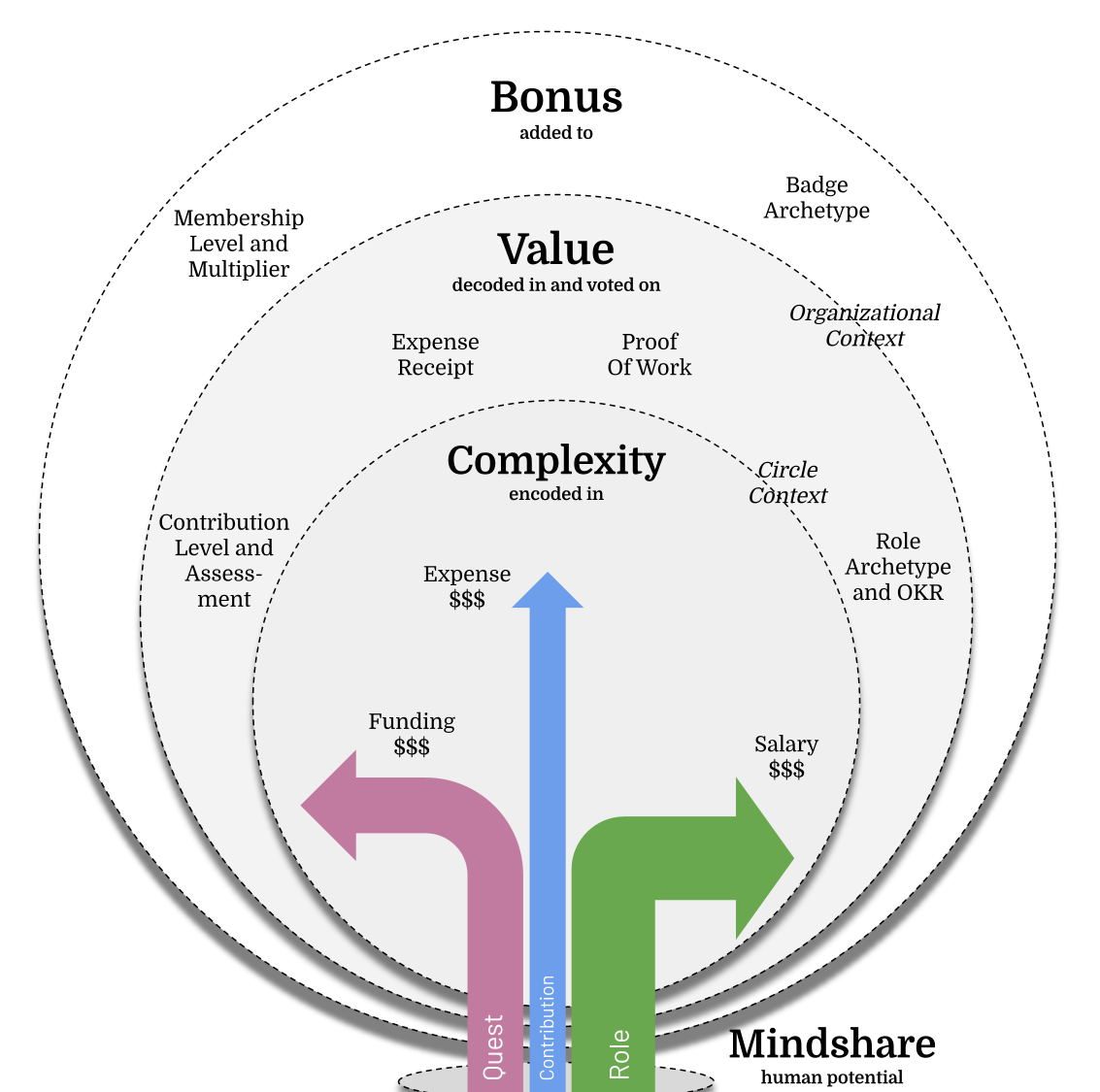
3. to better integrate 4 [key components](https://guide.hypha.earth/books/the-chronicles-of-samara/page/samaras-compensation-model "Samara's Compensation Model") of compensation:
1. **Mindshare** (how much of your life you give to Samara)
2. **Complexity** (the *anticipated* intensity or difficulty of the work you do for Samara)
3. **Value** (the *actual* value your contribution brings to the organization)
4. **Bonus** (the go-above-and-beyond recognition as a generic multiplier added on top)
To simplify the above interim model, we need to reconsider:
- pay out HUSD per collective schedule, not per individual need +1. This is why paying a maximum amount, at least when there is less than 3-4months reserved HUSD makes sense.
- uncouple commitment from contribution and salary bands
To integrate the 4 key components, we need to revisit the compensation model and start at the bottom:
1. Dividing mindshare into quests, contributions and roles
2. Encoding complexity *a priori* through the allocation of the funding, expenses and salaries
3. Decoding value *a posteriori* through the contribution level, proof of work and role archetypes (+OKRs)
4. Adding a bonus through the membership level and badge archetypes
Note that complexity is tied to a role-assignment within the context of a circle (e.g. a senior front-end developer for the DHO sub-circle in Hypha) and the value is decoded and voted on in an organizational context.
[](https://docs.google.com/drawings/d/e/2PACX-1vRXzZpsfgMspaTqhv418KqfJE8hiiUFXqhUjcYzmXGFzRQSe0YPMMvAn71_iHAPd_lsjONd6-Y9vk7x/pub?w=1133&h=1126)
### Implementation (How)
Let's try to spell out a possible new approach for Samara:
is there text that's coming here? seems implementation should come towards the end after we understand what the policy is. yes, didn't get to this yet
### Goals (TBD)
- try to move the salary discussions *off the table* so that they are no longer front-and-center (this is a major source of contention in any organization)
- try to stay away from any competitive measures (that lead to comparisons, e.g. my experience vs yours, my commitment vs. yours, my needs vs yours etc)
- find a compensation model that is (1) fair and equitable for members, (2) allows for a personal growth pattern, and (3) aligns with the goals of the organization
### Key principles (TBD)
- everyone has the freedom to choose their distribution of **mindshare**
- the overall distribution across all activities cannot exceed 100%
- you are encouraged to adjust your commitment levels accordingly
- there is no connection between level of commitment and complexity
- the circle (pod) decides what the level of **complexity** is for a given task/quest/role ("job")
- intense or difficult tasks/quests/roles are rewarded higher
- simple or repetitive tasks/quests/roles are rewarded lower
- alternatively, all tasks/quests/roles are rewarded equally
- the organization decides if the task/quest/role has contributed **value** to Samara or not
- tasks are proposed and voted on by each member
- quests are co-evaluated for each milestone and member
- roles (assignments) are evaluated and re-confirmed every 3 months
- the salary is based on a compound token model
- any work activity will earn 2x SVOICE in USD equivalent terms (investment activity is 1x)1
- What does the 1 reference to? Find it interesting that there is the suggestion of voice with investment. I would instinctively avoid this while recognizing that investors may well want some say in how the org works. In the end this is a choice about what Samara values most.
- long-term contributors are expected to earn proportionally more SAMARA tokens ("deferring", "having skin in the game")
- incentives for SAMARA tokens include a 1.8 multiplier that degrades over time
#### Band Definitions
- $70k annual salary
- Relatively Low Complexity - focused on doing - minimal time sensing and on calls - maximum time DOING!
- 60/20/20 - Doing / Sensing / Learning (within one circle)
**Mid Complexity Pay (B2):**
- $90k
- Requires much more headspace and managing overlapping topics, issues, information etc. Supporting multiple individuals.
- 40/40/20 - Doing / Cultivating (Sensing & Coordinating) with multiple individuals & circles / Learning
**Max Complexity/Intensity Pay (B3):**
- $110k
- Supporting and serving multiple circles, individuals, and the movement effectively.
- 20/60/20 - Doing / Cultivating (Sensing & Coordinating) with multiple circles & organizations / Learning
## Compensation models
Seems 1 & 2 are coincident possibilities people can choose for a specific context, whereas 3 is for a different context. Am I correct? if so, would be good to explain this more. Irina: Yes, tried to explain below with an update. Feel free to change to make it clear.Joachim: I would not call them models, more like a design philosophy? Other than that compensation is either fixed (based on role commitment and complexity) or variable (based on contribution and co-eval) Irina: Alternative to models? I just put options for now until we come up with something better. Not sure if and how we would like to continue with the variable compensation (based on the co-ev) after we start going into long term role assignments. How about you break it down into 3 horizons: short, mid and long-term, with horizon 1 covering immediate needs for some members (as we did), horizon 2 beginning the transition and understanding the tokens we'll use and horizon 3 assuming a more stable org with circles and roles. +1 framing and making 3 time horizon designs/proposals makes sense to me. At the moment I see them clashing in the thinking here. I feel we need to separate them so short term considerations are dealt with clearly but are not interfering with longer term goal of ongoing policy. Compensation options in Samara are currently designed based on two different contexts: 1. Periods of Official Samara quests (such as quests to Hypha or other entities providing quest-specific funding), when the following compensation options are available:
A. **Standard abundance compensation,** Samara token as compensation. Permanently available for Samara members.
- 100% Samara tokens, adding the multiplier in place
B. **Diverse compensation,** a model that includes other available tokens in the compensation when these tokens are available (like for example HUSD, Liquid Seeds etc.). This model is available whenever Samara has a diversity of tokens and Samara members decide to use those tokens as part of compensating member's contributions.
This model will be updated at the beginning of each quest period or whenever necessary, reflecting the available tokens.
- Contributors can choose a HUSD component up to 30% of their total contribution (unless HUSD reserves are low, in which case a cap is placed on total HUSD per month any one person can request. This cap is based on the amount that will ensure reserves do not reach 0, which becomes more and more important as operating costs besides compensation come into play).
- Contributors can choose liquid Seedscomponent within a total of HUSD + liquid Seeds being up to 50% of their total contribution. (Low reserve proviso same as above).
- The balance to 100% is made by Samara tokens, adding the multiplier in place
2. Periods in between Official Samara quests and before Samara enters into steady operations after the acquisition of substantial funding (definition of 'Steady Operations' and 'Substantial' TBD)
A. **Default model for in between Official Samara quests.** The purpose of this model is to continue supporting the long term Samara contributors with the fiat needed to cover life expenses while being able to continue to contribute to Samara.
Applicable to members with at least 3 months of past contributions at a commitment higher than 70%.
Note 1: Before engaging with a quest or a role assignment with Samara, members provide information for the minimum amount of HUSD (fiat) needs they require in order to have a long term engagement with Samara at the desired commitment level. Not sure what 'initial request' means. what is that? when was it? Irina: tried to add more details, better?
Note 2: For the period between quests starting with April 20, 2021 (not having a long history of past contributions behind) this model is applicable for past contributions higher than 50% in the 2 previous distinct evaluated periods (March 1 - March 12 and March 13 - April 19).
- define HUSD need in advance (based on fiat needs)
- propose commitment (%)
- do the Co-Ev process at end of commitment period
- update commitment
- use 3 salary bands related with contribution (%): 70k for 1%- 49% contribution, 90k for 50%-79% contribution, 110k for >80% contribution
- HUSD amount pay and the rest in Samara tokens with the multiplier in place
### Examples (What)
1. Jeff joins Samara as a new member and goes on an onboarding quest
2. After completion, he earns an Apprentice badge, some SVOICE and is looking for a long-term engagement
3. The XYZ circle has a new job posting at complexity level "B3" and archetype "building"
4. Jeff applies and is accepted into the new role and starts his new assignment
5. Each week month he claims to pre-defined tokens for the B3-Builder role
6. At the end of each quarter (or 3 months period) he documents progress in OKRs
---
1 This differs from the book, I believe Samara investors want to have a voice in decisions, that's why they invest, but that voice is lower than that for existing members enacting roles
Irina: I have some concerns of giving voice to investors. Let's discuss.Bongi: +1 re: voice to investors. This is very related to our identity and values and think this should go to a vote on Loomio after discussion.